
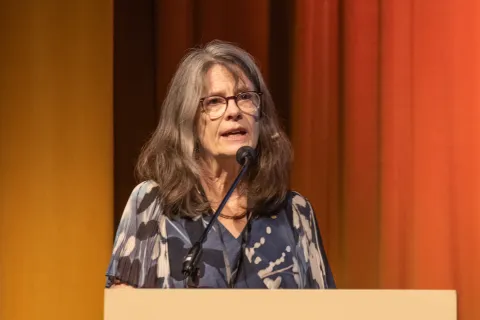
Impact Ignite Keynote Speaker: Dr. Mary Brunkow
In 2025, Dr. Mary Brunkow shared the Nobel Prize in Physiology or Medicine with Fred Ramsdell and Shimon Sakaguchi for their work on peripheral immune tolerance, the way the immune system learns not to attack the body's own tissues. Sakaguchi identified regulatory T cells. Brunkow and Ramsdell studied "scurfy" mice, which suffered from uncontrolled immune responses and fatal inflammation. They found the gene responsible, which they named Foxp3, in the last of twenty candidate genes. In 2001, they showed that mutations in its human equivalent cause an autoimmune disease called IPEX syndrome. Their discovery unlocked how regulatory T cells prevent autoimmune disease, and it now points to new treatments in cancer and autoimmunity.
Brunkow's early training followed the classic academic script. Born and raised in Portland, she attended St. Mary's Academy before heading to the University of Washington. She began college intending to study medicine, but a senior-year genetics course and a student research project in a professor's lab redirected her toward graduate school. She earned her PhD at Princeton, as one of the first graduate students in Shirley Tilghman's lab, then spent about four years as a postdoc in Toronto, where she built skills in manipulating large pieces of DNA and working with mouse mutants.
Then came the pivotal choice. By the end of her postdoc, she wanted her research to be "closer to application in the real world," so she turned to industry and joined a biotech start-up in Bothell, Washington, in 1994, as one of about thirty employees. There, she led a molecular biology group working closely with Ramsdell's immunology team, and in 2001 the discovery appeared in Nature Genetics.
What happened next is a familiar story in industry. The start-up was acquired, its new owner merged with another company, and the combined company closed the Bothell lab, ending in-house gene discovery. About ninety people lost their jobs, and Brunkow was among them. She took consulting and contract research work, completed a certificate in technical and scientific writing, and went on to science writing and program management.
The company closed—but the science endured. While Brunkow moved on to other work, Foxp3 went on to point the way toward new treatments for autoimmune disease and cancer. In 2025, a discovery made in a lab that no longer existed earned a Nobel Prize
That is why we invited her. A PhD trains scientists to take on problems no one has solved, and the habits it builds—persistence through failed experiments and flexibility when the question changes—outlast any single job. Brunkow's career shows how far they can carry you: through a lab closure, a change of field, and a path no one would have drawn in advance. Her own advice to young scientists is to "bear in mind that there are many ways to work in science." That is the spirit in which ARCS support its scholars: with the time and freedom to follow the question where it leads, and with belief in their path.
- Log in to post comments