
Learn Earth Day Information from ARCS Scholar Vanessa Hawkins
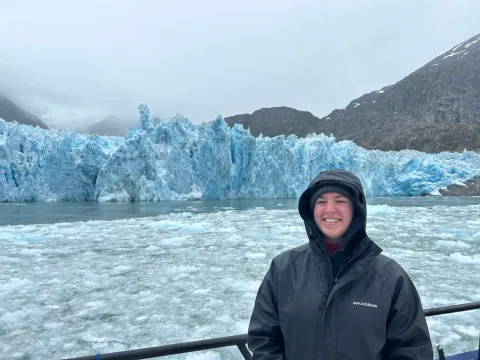
Vanessa uses ocean observations to study glacier ice-ocean interactions as a PhD student at Oregon State University.
During her undergraduate work, “I learned that I gravitate toward hands-on research where I can use physics as a tool to understand our changing planet, a topic I’m passionate about,” she says. “I decided to study physical oceanography at OSU, where I work with an incredible team to take ocean observations near glaciers.” She is a second year ARCS scholar at Oregon State University in the College of Earth, Ocean and Atmospheric Sciences.
In Vanessa’s words:
Glacial melt, especially from the Greenland Ice Sheet, contributes to sea level rise. Since Greenland’s glaciers flow into the ocean, it is thought that currents can affect how glacier ice melts beneath the ocean surface. It is difficult to test this with ocean observations near glaciers because large (house-sized!) chunks of ice can break off at any moment. In addition, there are often floating icebergs that prevent us from approaching the glacier in a large research vessel.
I study ocean currents at a glacier in southeast Alaska (Xeitl Sít' / LeConte Glacier), which is thought to behave similarly to Greenland’s glaciers. When you approach this glacier from the research vessel, it stands about 150 to 200 feet above the ocean surface, but the ice actually extends over 500 feet deep. At this depth, a substantial amount of rainwater and surface meltwater drains into the ocean (enough to cover a football field in a foot of water in 7 seconds!). Since this fresh water is much lighter than the heavy, salty ocean water, it forms a rising current called a buoyant plume. Underwater, the buoyant plume looks like a smokestack rising along the ice face.
It is difficult and dangerous to approach the glacier closely, so we use a fleet of robotic drifting instruments to study the buoyant plume. The drifters measure ocean temperature, salinity, and velocity, which I use in my research to understand how the water transforms as the drifters journey through the current. We have not been able to study buoyant plume dynamics with this kind of instrument before, and we hope to learn about small-scale mixing and how it varies in the plume over space and time.
Our project at Xeitl Sit’ involves observational oceanographers, engineers and modelers at Oregon State University, the University of Washington, and the University of North Carolina Chapel Hill. Expeditions happen in the summer: our team spent two weeks on a research vessel collecting data in July 2024 and 2025. The glacier environment is challenging, though: sometimes plans must change because of bad weather, too much ice cover, or malfunctioning instruments. It’s important to be flexible, stay alert, and work as a team—we want to prioritize the safety of the scientists and the ship’s crew.
Vanessa is a second year ARCS scholar and her award donors are Lara Ogg and Alexa Cunningham.
Earth Day will be observed April 22nd.
- Log in to post comments